Tuesday, October 13, 2020

October 12th, 2020 Edition


“Hey Chuck, who’s guarding me?  Do you have anyone assigned to guard me?  It’s too easy when I’m wide open like this.  If you don’t get someone on me, I’ll probably go off for 60 tonight!” – Larry “Legend” Bird to the opposing Detroit Piston head coach Chuck Daly


On this particular night (April of 1988) in the hallowed Boston Garden, Coach Daly gave a starting nod to the young athletic 2nd year pro in Dennis Rodman.  Daly also gave Rodman explicit instructions -- give 100% of your defensive effort onto one guy and one guy only: Larry Bird.  Well, Bird immediately realized the challenge and took it right to the young Rodman.  It did not take long for Bird to expose the inexperienced youth, and in typical Larry Bird fashion, he let everyone know -- both by his dominant play on the court and also for anyone within earshot – who the clear winner was of this mental game within the game. 

Bird finished with 32 points, 11 rebounds and 5 assists in 44 minutes of playing time.  The Detroit defensive specialist (Rodman), only garnered 24 minutes of playing time before fouling out with 9 points and 8 rebounds.  The Celtics went on to post a convincing 121-110 home win.  https://www.basketball-reference.com/boxscores/198804010BOS.html 

I don’t know about you, but it seems to me, that this general election is full of many games within the game being played.  Regardless of your political position, we should all be able to agree on what we know so far:

·         * Trump is holding very popular political rallies that the American people are responding to with a couple tens of thousands of folks in attendance regularly

·         * Conversely, Biden is taking a very low-key approach with safety around the pandemic being his primary concern and thus holding only a few subdued events

·         * Current political polls being reported by the main stream media reveal that Biden is leading in the race by 15-20% across the country

On the topic of the popular vote, we need to review some history to realize the impact of a 15-20% popular vote lead.  Back in 1972 President Nixon almost ran the table (49 states won) on his Democrat opposition (George McGovern) and concluded with a 23% vote margin.  In 1984 President Reagan equaled the achievement (49 states won) against the Democrat candidate Walter Mondale with an 18% popular vote margin.  In 1820, James Monroe won 99.5% of the casted Electoral College votes, but then again, Monroe ran unopposed.  https://www.britannica.com/event/United-States-presidential-election-of-1820

If Biden is ahead by a 15-20% points, why has he spent the past several days in Ohio and Pennsylvania?  If the current polls are true, Bidden/Harris should be campaigning in Wyoming and North Dakota soon.

We are already witnessing some interesting political “October Surprises”, and for those interested in watching, the games continue...


Weather and Corn Development

The day time high temps for the week will begin to wane after Monday, but we remain in our dry cycle with low relative humidity.  Accumulation of a few more heat units to help dry the corn and sunflowers will occur this week.  With daily high temps for the week primarily in the 50’s and 60’sF, we’ll forecast another 50-55 GDD’s over the next 7-day span.


The GDD map for our region since our killing frost on September 8th and 9th continues to highlight how fast the corn is drying down.  With over 230 growing degree days accumulated in most locations and close to 300 GDD accumulated since the frost in the heart of the valley over this time frame, it’s not surprising to continue to receive reports of some corn grain in the 15% to 18% range currently (more on corn drydown later).


There was a tad of scattered rain in places last week, but the rainfall map over the last month and a half continues to reveal dry conditions – especially in the northern half of North Dakota.  We’ll continue to look for some moisture to aid in the field work and to start next year’s crops.

I’ll count on your weather app for the best guidance through the 7-8 day forecast, but looking beyond that, I’ve found this site from NOAA to be fairly reliable for a general 8-14 day outlook (next week).  https://www.cpc.ncep.noaa.gov/products/predictions/814day/index.php

For the mid to late October timeframe, the forecast is to have greater chances of below average temperatures and below average precipitation.

The NOAA group also provides three month outlooks.  If we would like to get a general forecast for next spring (Mar-Apr-May), it can be seen here: https://www.cpc.ncep.noaa.gov/products/predictions/long_range/seasonal.php?lead=6

This forecast currently predicts below average temperatures, while also calling for greater chances of above average precipitation.  Hopefully, we see some moisture between now and then to place some humidity into the system so we can get some spring rains before the month of May hits and planters/drills begin to roll.


Regional Soil Temperatures

Speaking of field work, here is the current snap-shot for soil temperatures.  We should probably wait another week to see if most locations will fall under a 50F temperature reading before fall nitrogen applications start.  For farm operations focusing only on P & K fertility, these applications can occur at any time since they are not temperature dependent.


US Crop Progress

The USDA estimates corn harvest at 2/5ths of the way completed for the year across the US, and the soybean harvest at 3/5ths completed across the nation.  For North Dakota, these numbers are 25% for corn (9% for the 5-year average in the state) and 83% for soybeans (54% for the 5-year average).

The USDA reports the corn crop condition at 61% of acreage in the good to excellent category across the US (last week – 62%), and the North Dakota crop ratings held steady at 58% of the acreage in the good to excellent category.   Mature corn is estimated at 94% of the US acreage.  The prior 5-year average for corn maturity across the US is 87% (77% for ND).

For soybeans, USDA estimates 63% of acres will rate in the good to excellent category for crop condition (prior week of 64%).  However, North Dakota’s soybeans rate at only 47% good to excellent (down 1 point from 48% last week).  

The National Sunflower Association (NSA) estimated the nation’s sunflower harvest progress at 25% complete which would be about 2-4 weeks ahead of average pace.  The sunflower production is estimated at 2.81 bil lbs with an average yield per acre of 1,730 lbs (which would tie the record yield level).

By now, the traders know where this US crop is going to land for production and all eyes will be on the export and carry-over volumes looking ahead.

https://usda.library.cornell.edu/concern/publications/8336h188j?locale=en


Bayer AG® Stock Price Takes Another Hit

Bayer’s® communication to shareholders at the end of the 3rd quarter was pessimistic as they foresee a lingering pandemic response in agriculture on the global scale.  Bayer’s (BAYRY) stock price slump since then has eroded another $7.7 bil of company market value and now the entire Bayer company is valued less than the price they paid for Monsanto (US$63 bil) over two years ago (deal finalized in June of 2018).

Bayer’s® crop business is estimated at just under 50% of total sales for their company, and they forecast this segment of their business to face “deeper than expected” impacts that will expand past the short-term.

There has been speculation in the industry that BASF® wants a greater piece of the global agriculture business.  If this is true, maybe they should look towards Bayer® to potentially sell-off their agriculture assets.  It would make sense for the two German companies to combine assets as they should see more viable synergies with headquarters in the same country.

Meanwhile, Corteva’s® stock (CVTA) took a step upward in early October and currently is bringing over $33 per share – an all-time high for the company that began trading in June of 2019 at $24.50 a share.

It has also been rumored in the industry that BASF® is looking at opportunities to acquire Corteva®.  Let’s hope that doesn’t happen as I think a US based agriculture company is good for the American farmer as well as the American consumer, after all, the US is the largest food producing country in the world.  We’ll see how it plays out, but I think BASF® will have to look towards Bayer® or others if they want greater sales volume in agriculture.  In order for Corteva® to remain a pure play US based agriculture company, look for our stock price to continue upward movement to keep others from an aggressive move.

https://www.bloomberg.com/news/articles/2020-09-30/bayer-to-cut-1-8-billion-of-costs-as-covid-hits-agriculture


Corn Drydown Rates related to GDD’s

Last week, my numbers for GDD’s required to dry a point of moisture did not look right, so I went back to review some unpublished Pioneer data from 10-15 years ago and sure enough they were off a bit.  The data came from Nebraska and west, so much drier autumn climate in general but probably similar to our current 2020 conditions in eastern North Dakota and northwestern MN.  This prior mentioned data would indicate that it takes 17-22 GDD’s to lower the grain moisture each point from 35% to 22%, while 20-25 GDUs per moisture point are required from 22% to 15%. 

So, if we take a ball park figure of 270 GDD’s received this fall in our region from September 9th (our killing frost date) until now, we can estimate that we would have dried the corn around 15-20 points of moisture.  Now, most of the corn was not at black layer when the killing frost occurred, and if we assume a starting point of 37-38% grain moisture content on September 9th, you can easily figure current grain corn moisture contents in the upper teens to low 20% range.

As the corn continues to dry and we get later into the autumn, it will be more difficult to remove moisture as our air temperatures drop and humidity (if we can get a rain) is likely to increase.

As the corn gets drier, stalk integrity begins to fade as well, so keep a watch on hybrid standability as the autumn unfolds.

The University of Purdue had an article from September of 2018 on the drydown of mature corn:  https://www.agry.purdue.edu/ext/corn/news/timeless/GrainDrying.html

The article was written by R.L. (Bob) Nielsen and he reviews the key bullet points:

·        Weather conditions strongly influence the rate of grain drydown and each autumn is fairly unique to drydown rate – rain, humidity and sunshine all playing factors

·         Corn hybrid characteristics play a role as well

o   Ear husk number, thickness, length, senescence rate, and tightness around the ear all are factors

o   Pericarp (outside covering) thickness of the individual grain kernels – thinner pericarp allows the kernel to expel moisture more easily

o   Ear declination – ears that drop downward tend to dry more quickly as they are able to naturally shed any autumn moisture

·         Early maturity of hybrids typically means faster drydown – primarily due to the fact that there are greater chances of significant heat unit accumulation after reaching physiological maturity

·         Conversely, full season hybrids with later grain maturity will dry slower due to less potential of receiving significant heat units to dry the corn after black layer or physiological maturity is reached (this occurs later in the autumn for a full season hybrid versus an early season hybrid)

·         Corn grain dries through evaporative moisture transmission through the pericarp – there is no evidence of moisture loss through the pedicel (point of connection on the kernel where it attaches to the cob).


No 1099 Being Sent-out for PPP Loans

The federal IRS announced in late September that they are informing financial banking institutions to not distribute 1099 forms regarding PPP (Paycheck Protection Program) loan income.  This announcement basically transforms your PPP loan into tax-free grant dollars.  If your tax accountant has questions, forward them this weblink and state there is a phone number for assistance to help answer any concerns:

https://www.irs.gov/pub/irs-drop/a-20-12.pdf


Product Spotlight – P8736AM


Are there any corn hybrids that are consistently rising to the top during the corn harvest within Pioneer’s® line-up?  Well, for those in the 85 CRM zone, Pioneer’s® 87 RM hybrid is looking like a clear winner this autumn.  With its strong late season drought stress and stellar genetics against Goss’s Wilt, this hybrid is shining bright after the 2020 season.  We do have some concerns around harvest standability with scores of “4” for both roots and stalks, but we did recommend a kernel drop of 32,000 seeds/ac maximum last winter to assist with better standability.  Ear flex is good and the hybrid is responding well to these management tips so far this harvest.  The hybrid also rates at 87 RM for corn silage along with good quality scores for beef and milk production.  Silage Relative Maturity (RM) is the maturity it takes from corn planting to 65% whole plant moisture.  Typically, a rough rule of thumb is add 10 RM to a standard corn grain maturity for the area for hybrid silage production.

If you have questions or concerns about Pioneer’s corn line-up for silage and/or grain production, please be sure to contact your local Pioneer representative or myself.


EPA Reviewing a Phase-out of some Bt Hybrids

With pesticide resistance continuing to gain momentum across the US (and globally for that matter), the EPA is looking to implement some tactics to continue to combat the ever-evolving threat in the US. 

Multiple strategies are being discussed, but one idea is to eliminate the use of most Bt corn and cotton hybrids that contain only a single or dual Bt proteins – which is most of today’s hybrids.  Another tactic is to bring back isolated and separate refuge requirements for a “pure” insect breeding ground without the presence of Bt proteins (no blended products like AcreMax or RIB). 

Moving forward, new Bt proteins and multiple (three or more) stacks of different Bt proteins could be required to keep pest pressure susceptible to the technology and farmers satisfied with the control witnessed in the field.  Products containing Bt traits from Corteva®, Syngenta®, and Bayer® are being proposed for phase-out in only a 3 to 5-year timeframe.

The EPA is taking written comments until November 9th and it’s always informative if they can gather some insight from farm managers and ag-consultants.  If you’d like to submit your comments please see this site: https://www.federalregister.gov/.../epa-draft-proposal-to-improve-lepidopteran-resistance-management-notice-of-availability

http://news.agropages.com/News/NewsDetail---36787.htm


Random Agricultural Facts – Christopher Columbus

With Columbus Day occurring this Monday (Oct. 12th), here are some popular and unpopular facts about Christopher Columbus and the holiday in his honor:

  • Columbus Day has been a Federal US holiday since 1937, and since 1971 has always occurred on the second Monday of October
  • The date reflects Columbus’s arrival in the West on Oct. 12, 1492
  • Back in the 1700’s, scholars of the world were convinced the earth was circular in shape, but Columbus thought the planet was much smaller in size.  Thus, he thought they landed in Asia when reaching what is today the Bahamas
  • Once Columbus seen the natives, he called them “Indians” assuming he was in India
  • Although Columbus was of Italian nationality, he claimed the Bahamas and other Caribbean islands for the country of Spain as he was sponsored by the Spanish King and Queen to explore on their behalf
  • Columbus never set foot in the current contiguous United States
  • Columbus and his men are reported to have treated the natives very harshly, with some occurrences of enslavement and murder
  • He was sent back to Spain in shackles at one point because of his ruthlessness, poor leadership and lack of found riches
  • He died in May of 1506 – only 14 years after his maiden voyage west – still believing that he had found the shorter sailing route to Asia from western Europe
  • Columbus’s tie to agriculture?  He and his group started the first agriculture trading between the West and East.  Wheat, coffee, sugar and horses where some of the key items the native Americans first enjoyed from Europe.  While tomatoes, potatoes, and corn were the first products the Europeans enjoyed from the West
  • Many political groups across the US have successfully installed the observance of “Indigenous Peoples’ Day” on this same date.  These groups are looking to replace the Christopher Columbus holiday on a national scale with a day celebrating the indigenous native Americans – not a terrible idea, but let’s not forget the significance and history of Christopher Columbus in the process
  • On a side note, many historians believe that Leif Erikson was the first European to lead an expedition to North America.  It is believed that Erikson ventured west and south from Greenland into present day far eastern Canada around 1000 years ago – which was about 500 years before Columbus

·         If you are interested in a good read on Erikson and a couple cold hard facts about Norwegian inhabitance on the North American continent, it can be viewed here: https://cdnhistorybits.wordpress.com/2015/12/08/leif-erikson-vikings-canada/


https://www.biography.com/explorer/christopher-columbus


Monday, October 5, 2020

October 5th Edition


“Hell, this is my building – I’m not going to let anyone come in here and take a Game 7!” – Larry “Legend” Bird after Game 7 of the 1988 NBA Divisional Round of playoffs versus the Atlanta Hawks

 Dominique Wilkens may have had the better game stats – 47 points, 5 rebounds, 3 assists and 0 turnovers – versus Bird’s 34 points, 4 rebounds, 6 assists and 4 turnovers, but when it came down to the 4th quarter Bird placed the Celtic team on his back!  Bird scored 20 points in the 4th quarter alone to get the win (118-116) and offset Wilkins’ heroics, including Dominique’s own 16 points in the final quarter.  This Bird-Wilkins Game 7 clash is still highlighted as one of the greatest one-on-one single game battles of the NBA playoffs.

https://www.basketball-reference.com/boxscores/198805220BOS.html

 When it comes down to crunch-time and you need a big three or four-day push to complete harvest or beat a rain storm, who are the “big horses” on your employee team?  Every business has a small group of critical employees that know how to get the job completed properly, and thus are essential to your short and long-term success.  Making sure top employee talent remains on staff as a vital part of the team is key for any business – professional sports as well as farms.  I’m sure you will agree that finding ways to reward these employees with just a few more incentives than average is money well spent.  How does it reflect within the community if a local person is having to find a new employer every 6-18 months?  How does it look in the community if a farm business is consistently looking for employees and they have trouble retaining good help?  Like many things in life, it works both ways!

Fortunately, both people and businesses alike have opportunities to change their image and reputation, and it starts with dedication to discipline to accomplish the task.  If you are looking for some ideas, confide in a few trusted resources your objective and you’ll probably be surprised how others have encountered similar circumstances and you’ll be able to devise a game plan to alter the path you are currently travelling.


Weather and Corn Development

A seasonally warm week of weather will hit the far northern plains with high daily temperatures in the 60’s to mid-70’sF.  Warm temps with low relative humidity will continue to take moisture out of the crops quickly and I wouldn’t be surprised to see corn moistures fall into the 14-17% range by the end of the week in our region.  With the above average week of temps, we’ll accumulate another 60-70 GDD’s over the next 7-day span.


To highlight how fast the corn is drying down, lets utilize the GDD map to see how many heat units we have accumulated since our killing frost on September 9th.  With over 220 growing degree days accumulated in most locations over this time frame, it’s not surprising to receive some reports of corn grain in the 16% to 20% range currently.

As the corn crop dries down, it will require more and more additional heat units per point of moisture loss.  However, heat units are not the only factor in the equation as humidity, sunshine, and rainfall can all influence the rate of grain dry-down as well.

A general rule of thumb is that an average of 25-30 GDUs are required to lower the grain moisture each point from 32% to 25%, while 40-45 GDUs per moisture point are required from 25% to 20%.  With many local reports coming in drier than expected, it’s a sign that we’ve had low relative humidity over the past month along with our warmer than average temperatures.  As the corn continues to dry and we get later into the autumn, it will be more difficult to remove moisture as our air temperatures drop and humidity is likely to increase.

Lastly, as the crop naturally dries in the field, we will begin to see the internal integrity of the stalk start to break-down as well.  The corn crop seems to be standing well currently, but we don’t expect that to last much longer – especially as we see grain moistures drop below 15-16%.


The rainfall map for our region over the last month and a half continues to reveal that many locations are currently below average for soil moisture – especially in the northern half of North Dakota.  I think most farms would enjoy a good inch or two of precipitation before winter sets in completely to insure a good start to next season’s crops.

I’ll count on your weather app for the best guidance through the 7-8 day forecast, but looking beyond that, I’ve found this site from NOAA to be fairly reliable for a general 8-14 day outlook (next week).  https://www.cpc.ncep.noaa.gov/products/predictions/814day/index.php

For the mid-October timeframe, the forecast is to have greater chances of above average temperatures and equal chances of both above and below average precipitation (neutral for precipitation).

The NOAA group also provides three month outlooks.  If we would like to get a general forecast for the winter months, Dec-Jan-Feb, it can be seen here: https://www.cpc.ncep.noaa.gov/.../long_range/seasonal.php?lead=3

This forecast currently predicts below average temperatures, while also calling for greater chances of above average precipitation as well.  Hopefully, harvest pace remains strong and field work can be completed by early to mid-November to button things-up.


Regional Soil Temperatures

Speaking of field work, here is a nice snap shot of current soil temperatures.  Just to be on the safe side, maybe we should wait another week to see most all locations obtain under a 50F temperature reading before fall nitrogen applications start.  Many operations focus on P & K fertility in the fall and these applications are not temperature dependent.


US Crop Progress

With the corn harvest 1/4th of the way completed for the year across the US, and the soybean harvest recorded at 38% completed across the nation, it’s interesting to see the crop condition reports take a tick upwards.

The USDA reports the corn crop condition at 62% of acreage in the good to excellent category across the US (last week – 61%), and the North Dakota crop ratings moved to 58% of the acreage in the good to excellent category.   Mature corn is estimated at 87% of the US acreage (78% for North Dakota).  The prior 5-year average for corn maturity across the US is 78% (66% for ND).

For soybeans, USDA estimates 64% of acres will rate in the good to excellent category for crop condition (prior week of 64%).  However, North Dakota’s soybeans rate at only 48% good to excellent.  

The early September 8-9th frost across much of North Dakota is obviously playing with these USDA numbers.  I’d say yes, we lost some yield to the early frost, but yields were only affected by a couple bushel on fields where average to conservative maturity varieties were planted before – let’s say – May 20-22nd.  In fields where we had full season maturity soybeans planted on a date during the latter half of the planting window, yield was affected more dramatically.

https://usda.library.cornell.edu/concern/publications/8336h188j?locale=en


Farm Safety

I was fortunate enough to witness one of our local farm managers repeating safety instructions three times to one of his employees.  The farm manager had a crew working on the grain bin site, but the farm was starting to harvest corn for the day as well.  The obvious concern for safety was addressed and the clear instructions were repeated to insure everyone was on the same page. 

October usually is a busy month on the farm and this year it will be even a faster pace due to the warm and dry conditions allowing for many things to potentially be accomplished before winter arrives.  I can list a bunch of tips, but the main things are to allow time for everyone to obtain enough rest (sleep), take mental breaks during working hours, conduct some light stretching exercises a few times each day, and consume healthier than average nutrition to maintain clear thinking and high activity levels.


Dicamba Outlook Update

Well, a bit more insight is coming into the picture on the future of dicamba in RR2Xtend® and XtendFlex® soybean production.  The hearsay in the industry is that the EPA will make a ruling at some point in the current month of October.  The speculators also predict that the dicamba label moving forward will be more restrictive than it has been in the past from a federal standpoint.  If I’m reading the tea leaves correctly, that probably means that dicamba will be approved for only pre-emerge use only (application to occur after soybean planting, but before the seedlings emerge from the soil) in dicamba tolerant varieties.


XtendFlex® Granted European Union Approval

Also to note on the Bayer® front, is the EU approval of importing soybeans with the XtendFlex® trait package.  As you may recall, this will be Bayer’s® newest soybean herbicide trait package with the addition of glufosinate (LIberty™) into their already stacked trait package of Xtend® (glyphosate plus dicamba).  So now, with the three-way stack of glyphosate, glufosinate, and dicamba, Bayer® will bring a soybean offering to the table to compete straight-up with Corteva® and MS Tech’s® Enlist-3® (glyphosate, glufosinate, and 2,4-D choline).  The earliest XtendFlex® variety offering for our region will be on 07 maturity designation.

A couple things to remember… 1) until the EPA rules on dicamba the XtendFlex® is basically relegated to a RR/LL stacked soybean variety; 2) dicamba and glufosinate cannot be tank-mixed together as the glufosinate needs NIS additive (conversely NIS causes dicamba to become hyper-volatile); 3) 2,4-D choline has no state label restrictions and is labelled through R2 (full flower) growth stage with a tank-mix partner of glyphosate and up to R1 (first flower) with glufosinate 4) yield performance of the technology – the newest technology soybeans never are the best yielders.

https://www.dtnpf.com/agriculture/web/ag/crops/article/2020/09/28/xtendflex-soybeans-get-approval-2021  


Enlist-3® Soybean Variety Demand and Performance

Many seed companies have forecasted the demand for Enlist® soybean seed for the 2021 season to double versus the planted acres seen in spring of 2020.  If this forecast is true, there will not be enough Enlist-3® seed to meet demand – plain and simple.

While it is true that all seed companies do not have proprietary Enlist-3® genetics at this time, there are still many reasons to purchase your 2,4-D Enlist® soybeans from our Pioneer® company.  I can think of three-four main points off the top of my head:

·         Pioneer’s R&D program has accurately characterized these soybean varieties with sound agronomic scores for IDC, phytopthera, white mold, SCN (soybean cyst nematode), and maturity.  For example, some seed companies are stating that a certain Enlist® variety contains SCN protection while our research team clearly identifies the same variety without cyst protection.  These mis-characterizations can lead to some poor field placement recommendations and easily 10-15 bu/ac yield discrepancies

·         Second, Pioneer® LumiGEN® soybean seed treatment with Lumisena™ fungicide is a clear differentiator with Enlist® genetics.  It is known within the seed industry that the Enlist® varieties in general are not carrying as strong of IDC and phytopthera tolerances as the leading Xtend® varieties.  The addition of the Lumisena™ seed treatment was a clear winner in many locations this summer that received too much rain and subsequently fought root-rot pathogens

·         Third, Pioneer® sales agencies commitment to service.  Whether it’s handling a specific field agronomic issue or delivering your Pioneer® soybean seed directly to the farm or field, our professional seed agencies strive to deliver best in class service to support your farm business needs

·         Lastly, the Pioneer® brand will have the largest volume of Enlist® genetics available for 2021 sales to support our customers.  Our reputation of being viewed as a consistent and reliable supplier is important to us.

To highlight a couple of these bulletpoints, there was an excellent social media post by one of our Pioneer Territory Managers that revealed some of the wide discrepancy in soybean yields that we are seeing within the Enlist-3® platform.  As you can clearly see, there are some very weak performing Enlist varieties currently being offered.  If you are considering alternative brands for your farm’s soybean varieties next year, make sure your salesman has a portfolio of yield data to support his/her product recommendations from the local area. 


Typically, across a soybean plot, we see only a 7-10 bu/ac range and most of that can be attributed to maturity differences.  Seeing differences of 10-15 bu/ac plus is a sign that the genetics are below par – yield and agronomics – or, this season’s early September frost impacted the plot more than realized and the maturity designation on the specified variety is not even close to accurate (I’ve witnessed this as well).

Pioneer has Enlist® variety options in most all maturity zones (unfortunately nothing in the Group 00 maturity) and we’ll have the yield data and research to prove that our proposed varieties will perform as stated.  If your farm will be planting Enlist-3® soybean varieties in 2021, there are many reasons why they should all be Pioneer®!


Harvest Weed Seed Control Data

I’ve often referenced Redekop’s® (https://redekopmfg.com/...HWSC/ ) harvest weed seed control device mounted on the combine and now Missouri University has some field research data to continue to build interest in the weed management tool. The MU research is on a different branded device (Seed Terminator - https://www.seedterminator.com.au/ ), but I would think the data would be very similar (regardless of manufacturer). 

To review the research in a nutshell, two Missouri locations in 2019 had waterhemp infested soybeans which were harvested with the IWM tool.  Of the waterhemp seeds entering the combine, the mounted cage-mill device was able to damage between 98-99% of the seeds to a level where they could not germinate. 

The question now becomes how well does waterhemp retain its seeds late into the fall for capture with the combine during soybean harvest?  Well, a group of scientist have looked into it (https://www.cambridge.org/...waterhemp/palmer-soybean-maurity.pdf), and they found that both Palmer Amaranth and Waterhemp have consistently high seed retention (95-100%) with data coming from various US states and across multiple years (2013 and ’14).  Of course, there will probably be some header loss of weed seeds and some combine efficiency loss, but at least it looks to be a tool highly worth considering.

https://www.farmprogress.com/weeds/combine...harvest


Product Spotlight – P03A26X 


Are there any soybean varieties moving to the top of Pioneer’s offerings during the 2020 soybean harvest?  Well, in the 01-04 maturity zone, our P03A26X (dicamba) soybean variety is performing very well.  The P03A26X variety has strong field emergence, along with good white mold, IDC, and phytopthera root-rot tolerances.  One limit is the lack of soybean cyst genetic protection (SCN(, but we’ll still be able to place this particular variety across many acres in the region.  It seems to be a fit on many different soil types from heavy clay soils in the heart of the valley to the lighter rolling soils outside the valley due to its ability to fight and perform through challenging conditions.  If you will be planting Xtend® soybean varieties next year, please ask your Pioneer sales person about P03A26X!


Combine Harvesting Solutions – John Aubin

Last week, Pioneer sponsored a visiting ag consultant to the area in John Aubin.  Mr. Aubin has been running his business of “Combine Harvesting Solutions” since 2010 and relishes in opportunities to engage with farms while assisting with dialing-in the combine for maximizing efficiency in the field.

Pioneer Strategic Account Managers had stops with Mr. Aubin at numerous farm operations and everyone was impressed with his knowledge of all brands and models of combines as well as diagnosing and solving issues as they arose in the field.

A couple of key harvesting tips from Mr. Aubin include:

·         * Closely monitor the consistency of crop flow across the header and into the feeder housing.  The more consistent this flow is, the better the crop will thrash internally as the grain will naturally begin to separate as it rubs against itself (material on material thrashing) and therefore the less work the machine has to accomplish and the more efficient (greater speed/less grain loss) an operator will be able to obtain

·         * Insure the cross-auger in the header (if so equipped) is square from left to right in its height above the platform as well as in its depth from the back of the header – obviously a square header auger is essential to create consistent crop flow. 

·         * An improperly set header reel can be another cause of inconsistent grain flow

·        *  For corn, measure the diameter of a thrashed cob (millimeters) and then set the combine rotor clearance to that exact measurement as a starting point.  In this example (pic), the measurement is about 23 mm


·         * It’s a good practice to double check and potentially re-calibrate electronic measurement displays in the cab regarding combine settings.  Mr. Aubin stated to more than one operator that an electronic display can easily be off by a significant percentage and therefore could be the actual cause of excess grain loss despite the operator thinking the particular setting is spot-on or should not be adjusted any further

·         * Also for corn, make sure the deck plates are slightly wider apart at the rear (top) of the deck plates versus the bottom.  This will insure the rollers will more efficiently pull the stalk through and therefore more effectively managing the residue with potentially less stalk material having to move through the combine.

If you have a machine or two that isn’t gathering or thrashing grain as effectively as you’d like, or is having issues with excess grain loss or a dirty grain tank sample, I’d recommend giving Mr. Aubin a call.  He is excellent at walking through concerns over the phone or in the field and assisting growers in solving problems.  He is an independent consultant so he will charge for his time, but these charges are minimal when we are looking at the value of today’s commodity output and the number of acres a machine will harvest in a crop.  Plus, you are probably more economical and timely than a local equipment manufacturer sending out their technician.  John Aubin’s contact info is within his website:


http://www.combineharvestingsolutions.com/about-us/


Random Agricultural Facts – SHEEP

When you get a chance, ask your local butcher for a package or two of lamb chops and treat your next family gathering to a fantastic delicacy!

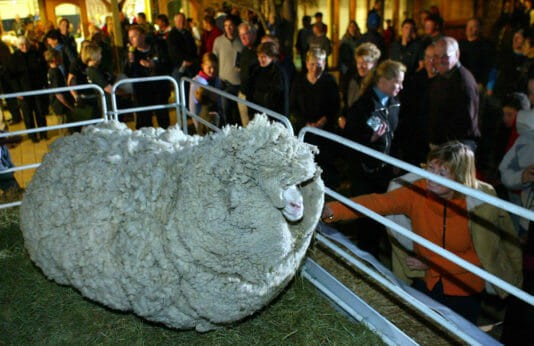
·         Domesticated sheep’s wool continuously grows.  Different breeds of sheep produce different quantities and qualities of wool.  The “Merino” breed is known for high quality wool, while the black face “Suffix” breed is known for meat production and poor-quality wool.  Below picture of a Merino ewe with approximately 6-years of wool growth before being sheared.

·         * Sheep have rectangular pupils and therefore have near 360o vision


·        *   Sheep have a unique lip structure, and thus can graze much closer to the ground compared to other ruminant animals

·         * US President Woodrow Wilson kept a small sheep herd on the White House lawn during WWI to minimize lawn-care costs while showing support for the war

·        *  USDA estimates about 153 mil lbs of combined lamb and mutton production in 2019.  Assuming minimal exports and imports and a US population of 330 million people, it equates to slightly less than ½ lb per person for the year for each American citizen.  I wonder how this number compares to the amount of pork (chops and bacon) consumed per US citizen each year?


https://modernfarmer.com/2017/12/6-facts-sheep-might-not-know/

https://www.nass.usda.gov/Statistics_by_Subject/...LAMB&MUTTON...


Thursday, October 1, 2020

Defining Corn Relative Maturity (CRM)

There can be a lot of confusion when it comes to corn maturity and company published numbers.  Typically, most folks in the industry converse about “days”.  I often hear from a customer, “I have Pioneer 83 day planted in the Home Half”.  Or, “91 day” or “85 day”, etc.  Well, that “83” number is actually the company’s published designated Corn Relative Maturity (CRM) for a stated hybrid.  The grain CRM for a corn hybrid is defined within Pioneer® as the maturity it takes for a hybrid to progress from planting through the season and ending at a “harvestable moisture” content under average conditions.  The CRM designation has nothing to do with a number of days to maturity, but is more related to growing degree (heat) unit accrual.

Each new hybrid coming along through a corn breeding program is measured against some very well-known benchmark hybrids to determine the relative maturity (RM) rating.  Researchers typically gain 6-7 seasons of data accumulation on a hybrid before it reaches commercial designation so the database is a robust set of observations at various locations to accurately designate a RM value.  “Harvestable moisture” obviously will vary from year to year based on weather, but more important is to remember an individual hybrid will vary in its grain drydown rate as well and this is factored into the CRM rating.


For grain RM designation, each individual RM score reflects about a 0.5 point moisture advantage.  Therefore, if you are comparing two hybrids from Pioneer® (planted and harvested on the same day), and one is designated at 79 RM and the other at 83 RM, there should be approximately 2 full points of grain moisture difference at harvest for maturity.

Many seed companies will publish a “physiological RM” (or black layer RM) which designates the maturity from planting to full physiological maturity.  Black layer will typically occur around 30-35% grain moisture content and thus this designation cannot take drydown into account.

If you are a corn silage producer, you need to inquire with your seed representative about “Corn Silage RM”.  This silage RM is defined within Pioneer® as the maturity from planting to 65% whole plant moisture, or the timing needed for optimum silage harvest to occur for ideal conditions around storage, feed quality, etc.  For silage RM, each one day difference between two hybrids (planted and harvested on the same day) will result in about a ¾ point moisture difference at cutting time.  It is very common to potentially have a 4-8 RM difference between grain CRM and corn silage RM.

Also in the Pioneer seed brochure, you will also notice a corn “Silking RM”, which is a rating of maturity from planting to first silk formation (may also be referenced as “Flower RM” from other companies but is slightly different as “flower” in corn refers to the tassel).  For those of you that may like to push longer maturities in your local environment, you should evaluate this number as hybrids that silk earlier compared to their stated grain RM tend to move north in our geography more effectively.

Lastly, please remember these definitions are for the Pioneer® brand and are not industry standard.  Each of the various seed companies in the industry could and does rate their products differently and I wouldn’t be surprised if you have experienced unexpected variability in this regard.